
Triad of Promotion, Openness, and Regulation: Insights into the Revision of China's E-Commerce Law
Tailored to emerging sectors like cross-border e-commerce and digital payments, the revised E-Commerce Law establishes three core pillars: promotion, openness, and regulation. The draft explicitly supports technological innovations, introduces international treaty application and "electronic document" mutual recognition, and implements a foreign-related mechanism encompassing investigations, multilateral consultations, and Reliable Entity Lists against foreign discrimination to safeguard outbound enterprises
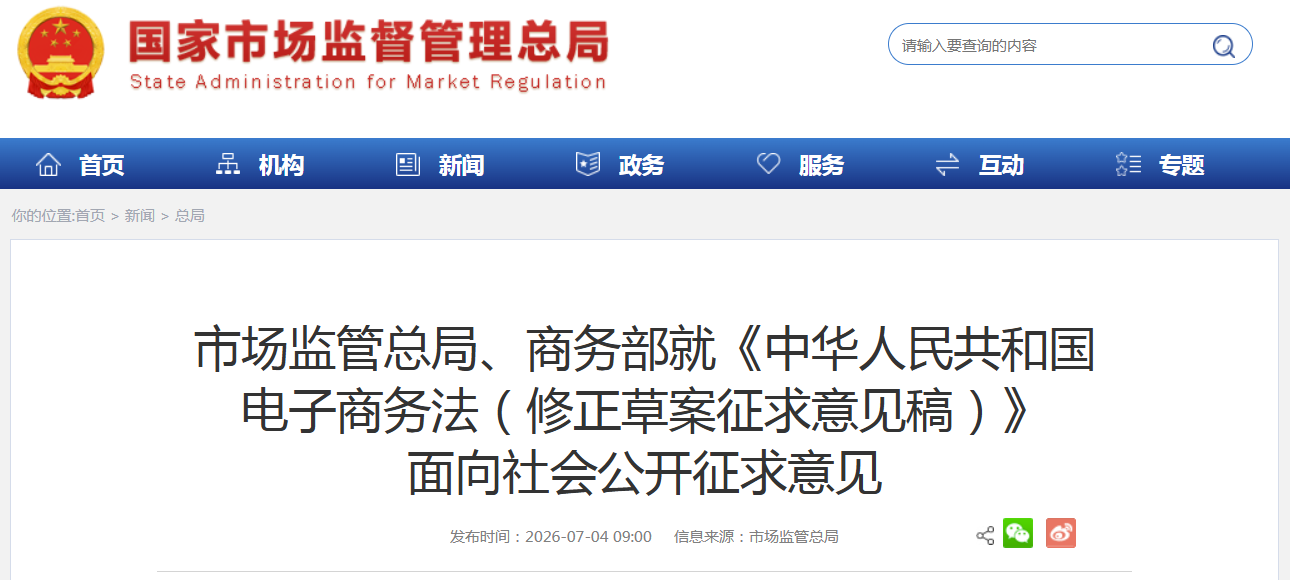
E-commerce, a crucial component of the digital economy, has become a vital force connecting production, distribution, consumption, and international markets. In recent years, new business models such as cross-border e-commerce, live-streaming e-commerce, instant retail, platform expansion overseas, digital payment, and overseas warehouses have rapidly developed, exhibiting three prominent changes: First, a stronger promoting effect, with e-commerce increasingly integrating with the real economy, leading to more significant impacts on industrial upgrading, improved distribution efficiency, and expanded consumption. Second, higher requirements for openness, with accelerated cross-border operations, brand expansion overseas, and platform expansion overseas, placing higher demands on rule alignment, standard mutual recognition, and rights protection. Third, heavier regulatory tasks, with issues such as platform responsibility, workers' rights, consumer protection, intellectual property rights, data security, and industry self-regulation becoming more prominent, necessitating legal amendments to improve the institutional supply. This draft amendment to the E-commerce Law of the People's Republic of China (for public comment) (hereinafter referred to as the "Draft Amendment") focuses on three main themes: promotion, openness, and regulation. It strengthens development promotion mechanisms, enhances the level of institutional openness, and improves the regulatory governance system, providing legal guarantees for promoting the high-quality development of e-commerce.
I. Emphasize the guiding principle of promoting e-commerce and consolidate the foundation for improving the quality and efficiency of e-commerce.
Strengthening the application of technological innovation to promote the high-quality development of e-commerce. The draft amendment to Article 67 improves upon this, proposing that "the state promotes the application of e-commerce in all sectors of the national economy, supports the integration of e-commerce with various industries, and supports the application of technological innovation related to e-commerce," with the addition of "supporting the application of technological innovation related to e-commerce." This amendment highlights the supporting role of technological innovation in the high-quality development of e-commerce. The accelerated application of technologies such as artificial intelligence, big data, cloud computing, intelligent logistics, digital payment, and electronic contracts is reshaping e-commerce transaction methods, service models, and governance methods. Adding the content of "supporting the application of technological innovation related to e-commerce" will provide a legal basis for the application of new technologies, platform model innovation, and digital transformation of the supply chain, promoting the transformation of e-commerce from scale expansion to technology-driven, efficiency-enhancing, and industry-empowering development, and better leveraging its role in promoting consumption, serving enterprises, and driving industrial upgrading.
II. Emphasize openness and enhance the level of institutional openness in e-commerce.
(I) Improving the support mechanism for innovative development and promoting the expansion of domestic and international markets. The draft amendment improves Article 3, proposing that "the state encourages the development of new e-commerce business models, innovation in business models, promotion of e-commerce technology research and development and application, advancement of the construction of an e-commerce integrity system, creation of a market environment conducive to the innovative development of e-commerce, and full play of the important role of e-commerce in promoting high-quality development, meeting the people's growing needs for a better life, and building an open economy. The Ministry of Commerce of the State Council shall formulate relevant policies for using e-commerce to expand domestic and international markets." This article reflects the state's encouragement and guidance for e-commerce innovation at the institutional and policy levels, focusing not only on technology and business models but also emphasizing the construction of integrity and a favorable market environment, thereby providing institutional guarantees for enterprise innovation. The newly added statement, "the Ministry of Commerce of the State Council shall formulate relevant policies for using e-commerce to expand domestic and international markets," further clarifies the government's responsibilities in policy formulation and guiding enterprises to expand markets. Its role is twofold: on the one hand, to promote enterprises to use e-commerce to expand domestic and international markets and enhance international competitiveness through policy support; on the other hand, to provide institutional basis and operational guidance for the development of e-commerce platforms and related industries, achieving an organic combination of innovative development and the construction of an open economy.
(II) Improving International Rules Cooperation Mechanisms and Promoting the Convergence and Compatibility of Rules and Standards. The draft amendment to Article 73 improves upon it, proposing that "the State promotes the establishment of exchanges and cooperation in e-commerce with different countries and regions, creates an open, inclusive, and non-discriminatory digital development environment, participates in the formulation of international e-commerce rules, and promotes the convergence and compatibility of rules, regulations, management, and standards in the fields of e-commerce transactions, payments, logistics, credit, and security. The State promotes international mutual recognition of electronic signatures, electronic identities, and electronic documents." This amendment further strengthens the orientation towards international cooperation and institutional openness in e-commerce. The addition of "creating an open, inclusive, and non-discriminatory digital development environment" is conducive to promoting a fair, transparent, open, and inclusive digital trade environment, reducing unreasonable digital barriers and rule discrimination, and creating more stable external conditions for enterprises to conduct international cooperation and cross-border operations. Furthermore, the addition of promoting the convergence and compatibility of rules, regulations, management, and standards in the fields of transactions, payments, logistics, credit, and security is conducive to promoting the alignment of rules, standards, and regulatory coordination in key aspects of e-commerce, reducing institutional transaction costs, and improving operational efficiency. The addition of international mutual recognition of "electronic documents" further enriches the content of digital mutual recognition, building upon the mutual recognition of electronic signatures and electronic identities. This will help reduce paper materials, duplicate authentication, and manual review in cross-border transactions, and promote the digitalization and facilitation of transactions, logistics, customs clearance, and settlement.
(III) Clarifying the rules for the application of international treaties and promoting the alignment of domestic and international laws. The draft amendment proposes adding a provision to Article 73: "Where an international treaty concluded or acceded to by the People's Republic of China contains provisions different from those of this law, the provisions of the international treaty may apply, except for those provisions on which the People's Republic of China has declared reservations." This amendment focuses on clarifying the relationship between the application of international treaties and domestic laws. With the rapid formation of international rules in areas such as e-commerce, digital trade, electronic documents, and electronic signatures, domestic law needs to reserve institutional interfaces for the application of international treaties to reduce conflicts in rule application. Clarifying the rules for the application of international treaties will enhance the legal certainty of cross-border operations, stabilize enterprises' expectations for going global, and provide an institutional foundation for my country's deep participation in the construction of international e-commerce rules.
(IV) Improve measures to address foreign-related issues and safeguard the rights and interests of enterprises going global in accordance with the law. The draft amendment suggests adding two new articles before Article 89: Article 1: If any country or region violates international law and the basic norms of international relations by taking discriminatory prohibitions, restrictions, or other similar measures against the People's Republic of China in the field of e-commerce, the People's Republic of my country may take corresponding measures against that country or region based on the actual situation. Article 2: If a foreign entity violates internationally accepted trade and economic rules such as non-discrimination, fair trade, and transparency, and harms the legitimate rights and interests of Chinese citizens and enterprises in e-commerce transactions, the Ministry of Commerce of the State Council may investigate the behavior of the foreign entity in accordance with relevant laws and regulations, decide whether to include the entity in the unreliable entity list, and decide on measures such as warning of transaction risks, restricting or prohibiting it from engaging in e-commerce investment activities related to China, based on the actual situation. This amendment focuses on maintaining fair competition and legitimate rights and interests in an open environment. With the rapid advancement of enterprises, brands, and platforms going global, unfair treatment such as account restrictions, product delisting, fund freezing, refusal to provide service, differential pricing, and discriminatory entry barriers occur frequently. The addition of relevant clauses will help to bring the risks of enterprises going global and external discriminatory restrictions into the national level for legal handling, enhance my country's ability to respond to foreign-related risks in e-commerce, safeguard the legitimate rights and interests of enterprises and the interests of industrial development, and promote the formation of a fair, open and non-discriminatory international development environment for e-commerce.
The draft amendment adds a new clause after Article 63: "The Ministry of Commerce of the State Council, in accordance with this Law and other relevant laws, shall conduct multilateral and bilateral consultations and negotiations, establish cooperation mechanisms, and handle dispute resolution regarding discriminatory policies and measures imposed on Chinese citizens and organizations by other countries, regions, or foreign entities in the field of e-commerce." This amendment clarifies the responsibilities of the Ministry of Commerce in responding to such issues, strengthens the protection of my country's rights and interests in e-commerce involving foreign entities, and provides institutional support for Chinese enterprises to go global and operate internationally.
III. Emphasize standardized guidance to promote the healthy and orderly development of e-commerce.
To improve industry self-regulation mechanisms and standardize the collaborative governance of e-commerce, the draft amendment adds a new clause after Article 73, proposing to "give full play to the coordinating and self-regulating role of legally established e-commerce associations, chambers of commerce, and other industry organizations, with industry management departments providing them with policy and business guidance." This new clause strengthens the social collaboration and industry self-regulation functions in e-commerce governance, clarifying that e-commerce associations and chambers of commerce can play a coordinating and self-regulating role. This leverages the advantages of industry organizations—their proximity to market entities, familiarity with industry operations, and ease of communication and coordination—to supplement governance in areas such as compliance guidance, standard promotion, dispute resolution, risk warnings, and integrity building, thereby enhancing the industry's self-management and self-regulation capabilities. Simultaneously, it clarifies that industry management departments will provide policy and business guidance to associations and chambers of commerce, which helps ensure that industry self-regulation aligns with laws, regulations, regulatory requirements, and public interests, preventing industry organizations from deviating from the path of standardized development. Overall, this new clause is conducive to improving the e-commerce governance structure that combines government supervision, industry self-regulation, platform autonomy, and social supervision, enhancing the professionalism, collaboration, and effectiveness of industry governance.