
From Trade Countermeasures to Digital Governance: The Proposed Anti-Discrimination Clauses in the Revision of China's E-Commerce Law
Addressing foreign restrictions in digital sectors such as platform access, app distribution, and data interfaces, SAMR and MOFCOM propose adding anti-discrimination clauses to the E-Commerce Law. Acting as a scenario-specific extension of existing foreign countermeasure frameworks, the clause aims to build a clear and restrained legal defense tool via defined triggers, procedural safeguards, and safe harbor mechanisms, stabilizing compliance expectations for cross-border e-commerce and MNCs.
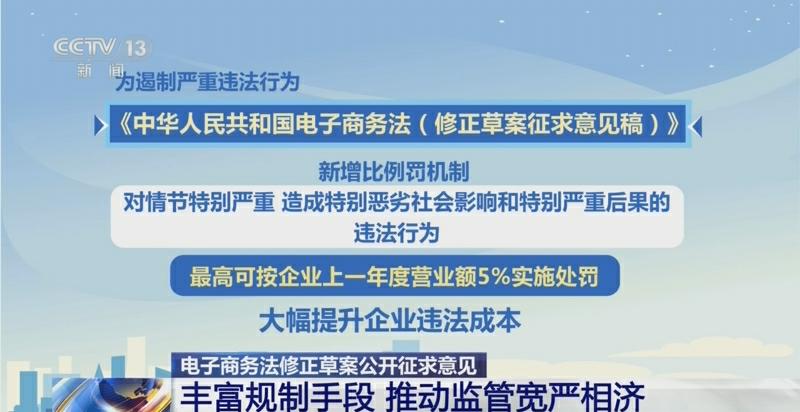
E-commerce and other digital sectors are becoming new focal points for external trade restrictions against China. Foreign restrictions are no longer limited to tariffs, quotas, or traditional import bans, but can be transmitted through platform access, application distribution, payment settlement, low-value parcel treatment, cloud services, data interfaces, and supply chain compliance systems. Recently, the State Administration for Market Regulation and the Ministry of Commerce released the "Draft Amendment to the E-commerce Law of the People's Republic of China (for Public Comment)," adding provisions for responding to discriminatory restrictions in the e-commerce sector. This is not the creation of a new, borderless countermeasure power detached from the existing system, but rather a specific and scenario-based application of the reciprocal countermeasure rules already established in the "Foreign Trade Law," "Foreign Relations Law," and "Anti-Foreign Sanctions Law" to the e-commerce field. Its legitimacy stems not only from the core legal authorization but also from the established precedent of "foreign discriminatory measures, investigations, and corresponding restrictive measures" in State Council administrative regulations. However, the crucial issue is not whether the state has the necessary institutional space, but rather how to ensure that this provision is developed into a clear, restrained, and predictable legal tool through triggering conditions, procedural safeguards, the principle of proportionality, and the safe harbor mechanism.
I. External risks in the e-commerce sector are changing their form.
In discussing whether this clause should be added to the E-commerce Law, we must first dispel a misleading premise: e-commerce is not merely domestic online retail, nor is it simply a matter of platform responsibility, consumer protection, and business registration. With the development of cross-border e-commerce, social e-commerce, platform expansion overseas, and digital service trade, e-commerce has become a crucial infrastructure for foreign trade and the digital economy. Platform access, application distribution, cross-border payments, cloud services, logistics fulfillment, data interfaces, advertising, and algorithm recommendations can all determine whether an e-commerce company can enter overseas markets, reach consumers, and complete transactions.
This means that the role of external restrictive measures is changing. Traditional trade restrictions are mainly implemented through tariffs, quotas, licenses, and import bans; in the digital economy, restrictions may transform into platform bans, app store removals, payment channel cutoffs, discriminatory treatment of low-value parcels, refusal of logistics services, suspension of cloud services, or data submission requirements. They may also be used to exclude businesses from the market under the guise of supply chain due diligence, human rights compliance, cybersecurity, and product safety. These measures, ostensibly platform rules, compliance requirements, or commercial audits, may in reality be the result of national measures, regulatory pressure, or political standards being transmitted to e-commerce and supply chain companies.
Risks in the e-commerce sector are therefore characterized by platformization, chain-like processes, datafication, and cross-entity transmission: a single restrictive measure may simultaneously affect platform operators, merchants, payment institutions, logistics companies, data service providers, advertising service providers, and consumers. While relying solely on traditional foreign trade rules or general anti-sanction rules can provide a basic basis, it may not be sufficient to clearly present the unique characteristics of this scenario.
II. Nature and Positioning of the Clause: A Connecting Interface for E-commerce Scenarios
The nature of the proposed additional clauses should be accurately defined: it is not a newly established, independent, complete, and boundless anti-sanction system under the E-commerce Law, but rather a connecting and specific expression of existing foreign trade and economic countermeasure rules in the e-commerce, cross-border e-commerce, and digital trade scenarios. This positioning is crucial. If interpreted as the former, the clauses could easily be questioned for being overly authorizing, redundant, or even creating uncertain impacts on the foreign investment business environment; if interpreted as the latter, its legality and necessity are clearer—the state is not creating new powers out of thin air in this law, but rather, under the authorization of the existing legal framework, transforming relevant rules into identifiable, applicable, and connectable institutional arrangements in the e-commerce field.
It is necessary to distinguish between "whether the existing system exists" and "whether the e-commerce scenario is fully expressed." my country does not lack the institutional foundation for countering sanctions, undue extraterritorial jurisdiction, and discriminatory restrictions; the Foreign Trade Law, the Anti-Foreign Sanctions Law, the Foreign Relations Law, and related administrative regulations already form the main framework. The problem lies in the fact that these systems mostly use general expressions related to trade, sanctions, national security, supply chain security, or the actions of foreign entities, failing to adequately address the specific aspects, transmission paths, and risk types of e-commerce. Therefore, the main value of adding clauses lies not in creating stronger countermeasures than existing laws, but in establishing a clear entry point into the e-commerce scenario: when foreign measures discriminate against Chinese e-commerce entities through platforms, payments, logistics, data, cloud services, advertising, application distribution, or supply chain compliance, the legal system is capable of identifying and responding according to law. This rule-based expression also helps stabilize business expectations—rather than relying on catch-all clauses or temporary policies in individual cases, it is better to pre-define the triggering conditions, the responsibilities of the competent authorities, and procedural principles, making the boundary between normal business activities and political exclusion easier to identify, allowing foreign-invested enterprises, platform enterprises, and cross-border e-commerce entities to make compliance judgments accordingly.
III. Domestic Legal Basis: From Main Legal Framework to Specialization in E-commerce Scenarios
The legality of the proposed additions is primarily based on several laws enacted by the Standing Committee of the National People's Congress; recently promulgated administrative law rules provide a similar institutional precedent. These two are at different levels and should be considered separately.
The most direct source of this rule comes from the Foreign Trade Law. Article 10 of this law establishes a fundamental principle: if any country or region adopts discriminatory prohibitions, restrictions, or other similar measures against the People's Republic of China in trade, the People's Republic of China may take corresponding measures against that country or region based on the actual circumstances. Cross-border e-commerce essentially involves the import and export of goods, the import and export of technology, international trade in services, payment and settlement, logistics fulfillment, and platform services, and is an important manifestation of foreign trade and digital trade. Incorporating this rule into the E-commerce Law is not an expansion from the foreign trade field to unrelated areas, but rather a more specific expression of digital transaction forms within the already covered foreign trade relations.
The Foreign Relations Law provides a higher-level national basis for countermeasures. For actions that violate international law and basic norms of international relations, and endanger my country's sovereignty, security, and development interests, the state has the right to take corresponding countermeasures and restrictive measures. Once external restrictions in the e-commerce sector harm the legitimate rights and interests of my country's platform enterprises, cross-border e-commerce supply chains, digital trade order, or related operators, and endanger national security and development interests, they cease to be merely commercial disputes involving individual companies and enter the scope of foreign-related rule of law and the protection of national interests.
The Anti-Foreign Sanctions Law and its implementing regulations elevate countermeasures from policy-level case-by-case responses to legal-level institutional authorization, and refine them into actionable tools. The law not only stipulates a countermeasure list and several specific measures, but also allows relevant laws, administrative regulations, and departmental rules to stipulate other necessary countermeasures through open-ended clauses. The 2025 Implementation Regulations of the Anti-Foreign Sanctions Law of the People's Republic of China (State Council Decree No. 803) further refines these measures to include restrictions on the import and export of goods and technology and international service trade, restrictions on transactions and investments in China, restrictions on the cross-border provision of data and personal information, and restrictions on entry, exit, and residency qualifications. This "law + supporting measures" structure is highly compatible with e-commerce: platform transactions correspond to transactions and cooperation; cross-border e-commerce corresponds to import and export and international service trade; platform operation and advertising correspond to data processing; and payment, logistics, and cloud services may constitute important links in digital service trade. Therefore, the addition of countermeasures clauses in the e-commerce sector to the E-commerce Law is a typical example of the situation accommodated by this open structure. This law does not break through the Anti-Foreign Sanctions Law, but rather makes scenario-based arrangements for the special risks in the e-commerce sector within its framework. From the perspective of the inheritance relationship of the existing system, there is no regulatory break.
The 2026 "Regulations of the State Council on Industrial and Supply Chain Security" (State Council Decree No. 834) authorizes relevant departments to conduct investigations into situations where foreign countries, regions, or international organizations violate international law and basic norms of international relations by taking discriminatory prohibitions, restrictions, or similar measures against my country in the industrial and supply chains, and by implementing or assisting in acts of harm. These regulations allow for the imposition of corresponding measures, such as prohibiting or restricting the import and export of relevant goods or technologies or international trade in services, and imposing special fees. When necessary, relevant organizations and individuals may be included in a countermeasure list in accordance with the "Anti-Foreign Sanctions Law" and its implementing regulations. Its structure can be summarized as follows: discriminatory foreign measures are the triggering premise; investigations by relevant departments are for fact-finding; and restrictions on import and export and international trade in services are the subsequent tools. This is highly similar to the proposed additional clause—the e-commerce sector may also suffer from discriminatory restrictions from foreign countries, also requires investigation to ascertain the facts, also involves goods, technology, services, data, transaction cooperation, and supply chain security, and also needs to strike a balance between appropriate measures and the principle of proportionality.
The "Regulations of the People's Republic of China on Combating Undue Extraterritorial Jurisdiction by Foreign Countries," promulgated at the same time, established mechanisms for identification, interviews, orders to rectify, prohibition of enforcement (injunctions), a list of malicious entities, and exemptions. Compared with the Ministry of Commerce's "Measures for Blocking the Undue Extraterritorial Application of Foreign Laws and Measures" in 2021, the relevant tools have been elevated from departmental rules and case-by-case lists to a systematic arrangement at the level of administrative regulations.
From this series of precedents, we can draw a "natural inference": since the State Council can establish an investigation and countermeasure mechanism against discriminatory measures against foreign countries in the form of administrative regulations and based on higher-level laws, then it is naturally more legitimate for the Standing Committee of the National People's Congress to establish a similar mechanism in the form of laws in the E-commerce Law, which has a higher regulatory level and is more in line with the principle of legal reservation.
IV. Comparative Perspective: Common Trends in Countermeasures, Blockades, and Counter-Coercion Tools
The significance of comparative law lies not in providing direct authorization for Chinese legislation, but in demonstrating that such institutional arrangements are not isolated cases. Faced with economic coercion, undue extraterritorial application, secondary sanctions, supply chain exclusion, and restrictions on digital services, major economies generally reserve defensive tools in their domestic laws for their enterprises, markets, and public interests. In other words, against the backdrop of intensifying geoeconomic competition, trade retaliatory measures, blocking rules, and anti-coercion tools are shifting from exceptional institutions to permanent tools in foreign trade and economic law.
The EU's Anti-Coercion Instruments (Regulation (EU) 2023/2675) is the most valuable reference. This regulation applies to economic coercion from third countries and establishes a procedural framework from review, identification, consultation to taking EU response measures. Its key feature is that it first determines whether the third-country measures attempt to influence the EU or member states' sovereign choices through trade or investment pressure, then uses dialogue, consultation, and international cooperation to persuade the other party to cease coercion, and only takes action as a last resort when necessary. Its response measures are broad, including imposing or restoring tariffs, setting import and export restrictions, restricting the transit or internal circulation of goods, excluding third-country participation in government procurement, restricting trade in services, restricting foreign direct investment, restricting intellectual property protection or commercial use, and restricting financial services. This demonstrates that major economies' tools for dealing with external coercion are no longer limited to traditional goods trade, but cover trade in services, investment, financial services, government procurement, intellectual property, and supply chain-related aspects—e-commerce and digital trade are precisely at the intersection of these aspects.
The EU's blocking regulations (Council Regulation (EC) No 2271/96) represent another type of institutional logic. They do not target economic coercion itself, but rather the extraterritorial effects of third-country law: requiring affected entities to report, prohibiting EU entities from complying with specific third-country extraterritorial legal requirements, stipulating that foreign judgments and decisions based on relevant extraterritorial laws are not recognized or enforceable in the EU, and allowing injured entities to seek compensation for damages, thereby protecting EU businesses and maintaining the autonomy of the EU legal order.
The UK's Protection of Trading Interests Act 1980 follows a similar approach, aiming to protect UK entities from the impact of specific extraterritorial sanctions on legitimate trade. It prohibits direct or indirect compliance with these sanctions, requires reporting, allows for recourse for losses, and establishes an authorization mechanism that allows entities to apply for compliance with relevant foreign requirements to a specific extent when non-compliance would seriously harm their own or UK interests. This aligns with the typical dilemma of blocking legislation—protecting the domestic legal order while simultaneously mitigating the dual compliance predicament of businesses through authorization or exemptions.
Canada's Foreign Extraterritorial Measures Act addresses the impact of foreign laws, courts, and administrative measures on Canada's trade interests, sovereignty, and commercial activities. It authorizes the Minister of Justice to restrict the provision of records and information to foreign authorities under certain circumstances, prohibits Canadian entities from complying with foreign measures that affect international trade and Canada's sovereign interests, stipulates that certain foreign judgments are not recognized, enforceable, or may be reduced, and allows affected entities to seek recourse. Its focus is on using domestic law to counteract the undue spillover effects of foreign laws, judgments, and administrative measures.
The United States takes a different approach. It doesn't primarily protect its companies from foreign sanctions through blocking laws, but rather has long relied on a system of domestic sanctions laws, export controls, investment reviews, and executive orders to translate national security, foreign policy, and economic security objectives into restrictions on transactions, assets, technology, finance, and market access. The Treasury Department's Office of Foreign Assets Control (OFAC), for example, bases its sanctions on foreign policy and national security, employing comprehensive or selective measures and achieving its policy objectives through asset freezes and trade restrictions. This suggests that major economies generally retain strong tools in the intersection of security and trade, differing only in their institutional focus and narrative.
These experiences offer at least three key insights. First, countermeasures, blocking, and anti-coercion tools are no longer unconventional measures for individual countries, but rather institutional choices for major economies to safeguard their legal autonomy, market interests, and national security under external pressure. Second, the scope of modern tools has significantly expanded beyond traditional goods trade, extending to services trade, digital services, investment, finance, intellectual property, government procurement, data, and supply chains. Third, the stronger the tool, the more procedural and proportional it needs to be: the EU's anti-coercion tools emphasize review, consultation, last resort, and ex post assessment; and the blocking regimes of the EU, the UK, and Canada all include reporting, exemption, authorization, or damage recovery mechanisms.
Looking back at the proposed additions to the E-commerce Law, their comparative law significance lies not in imitating a particular system, but in translating China's existing foreign-related countermeasures tools into the digital trade and e-commerce scenarios, and clearly defining their applicable boundaries in legal form. The e-commerce sector naturally spans goods, services, investment, data, platforms, and supply chains—precisely the intersection covered by comparative law tools from various countries. China's inclusion of transitional clauses in the E-commerce Law is not unusual in its direction. What truly needs to be grasped is that it cannot merely absorb the "strength of the tools," but also the "procedural constraints" and "corporate buffer mechanisms," making this interface a restrained, transparent, and calibrable legal tool, rather than a generalized trade retaliation clause.